
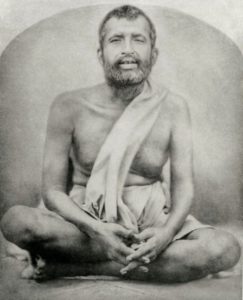
Sri Krishna proclaims in the Bhagavad-Gita, “Whenever virtue subsides and vice prevails, I come for the protection of the good; for the destruction of immorality I am coming from time to time.” In the present age, it is Sri Ramakrishna (1836–1886) who came to put the old principles of the Vedas and Upanishads in the language of today, thus relieving the humankind of sorrow and suffering, and showing the way for Self-illumination.
Sri Ramakrishna saw God in everything and admonished people who called themselves as sinners. ‘If you keep repeating that you are a sinner, sinner you will become; if you say that you are a child of God, divine and fearless you will become.’ That is why he reminded everyone of one’s divine nature, become aware of it and reclaim one’s heritage. According to him only by realizing God, who is Bliss Absolute, can humanity achieve the greatest happiness and end all sorrows that afflict it.
Is the goal of realizing God practical? Can one realize or see God? Sri Ramakrishna’s answer was an emphatic yes. He said that God could be experienced; one can talk to Him, and put one’s demand before Him. His prescription to realize God was to renounce lust and gold (kama and kanchan), and yearn for God instead.
Holy Mother Sri Sarada Devi once said that renunciation was Master’s ultimate message. But the Master prescribed different degrees of renunciation for his monastic and householder disciples. For the former, he said that monk must practice both outward and mental renunciation. But for the householder disciples, he prescribed only mental renunciation because they had duties toward their parents, spouses, and children. He advised them to live in the world like a maidservant, who outwardly calls her master’s sons as her sons, but whose mind is on her own children in a distant village from where she came. He further told them to seek holy company and go into solitude to practice meditation.
His teachings were based on his own experiences. Money, name, and fame did not attract him, so much so that even if someone offered money to him to improve his living conditions, he would get annoyed with him. His only passion since his early childhood was to realize God. He dropped out of school because “what shall I do with a mere bread-winning education? I would rather acquire that wisdom which will illumine my heart and give me satisfaction forever.”Though the Master didn’t have any formal education in secular or sacred literature, yet the most brilliant and learned people of the time found in him an intellectual giant. Among the many people used to keep spellbound for hours were Vidya Sagar, Brahmo Samaj leader Pratap Chandra Sen, Dr. Mahindranath Sarkar, Bankim Chandra Chattererji, Girish Ghosh, and Mahendranath Gupta. The last two were his household disciples, and Mahindranath Gupta was also the chronicler of the Gospel of Sri Ramakrishna with a pseudo name of M.

Like ancient sages and rishis, he spoke in parables or in contradictions. He once told Vidya Sagar: all scriptures like the Vedas, Vedanta, Puranas, etc. have been defiled by the tongue of man because they have been uttered through his mouth; only Brahman has never been so defiled because no one has been able to say what Brahman is. Vidya Sagar, a great scholar in his own right, remarked: ‘I have never heard such an apt description of Brahman!’ To reinforce his point the Master gave another parable: A salt doll went into an ocean to measure its depth. But no sooner did it enter the ocean than it melted away. Who could then tell the ocean’s depth?
One of the important features of his teachings is the harmony of religions. Rig Veda says: Truth is one; sages call Him by various names. The Master said the same thing: as many faiths, so many paths. But he didn’t say out of any sentimental reason but from his own realizations. He was the only person in the religious history of the world who practiced not only the religions of various Hindu sects but also practiced both Islam and Christianity. It is this that makes his assertion that all religions lead to the same Truth so authentic and credible.
Again, some said that God is Impersonal, while others said that God is Personal. Sri Ramakrishna said that God is both Impersonal and Personal. Said he:
Infinite is God and infinite are his expressions. He, who lives continuously in the consciousness of God, and in this alone, knows him in his true being. He knows his infinite expressions, his various aspects. He knows him as impersonal no less than as personal.
He once told M. that God is not only without form, but it has also a form. But one should hold onto one’s own faith and not criticize others. To bring home this idea he illustrated it with the following parable:
Brahman, absolute existence, knowledge, and bliss, may be compared to an infinite ocean, without beginning or end. As through intense cold, some portions of the water of the ocean freeze into ice and the formless water appears as having form, so through intense love of the devotee, the formless, absolute, infinite Existence manifests himself before him as having form and personality. But forms and aspects disappear before the man who reaches the highest samadhi, who attains the height of nondualistic philosophy, the Vedanta.
About his Master, Swami Vivekananda said after his return from the West: ‘…if I told you one word of truth, it was his and his alone, and if I have told you many things which were not true, which were not correct, which were not beneficial to the human race, they were all mine, and on me is the responsibility.’ Truly while Sri Ramakrishna was a form without voice, his disciple Swami Vivekananda was the voice without form.